Powered By Blogger

Thursday, 11 December 2025

#FOOTBALL4SCHOOLS

FIFA Football for Schools Mobile app available for stakeholders
2 years ago

The FIFA Football for Schools free digital application (Football for Schools) is accessible to the General Public via Google Play and the Apple App Store.

The Mobile app provides an online learning platform with relevant content for all stakeholders of the programme.

The Football for Schools Programme which was launched in Ghana on August 12 seeks to make football more accessible to both boys and girls around the world by incorporating football activities into the education system.

As part of the launch, the GFA worked with the Ministry of Education, the Ghana Education Service (GES) and the Ministry of Youth and Sports to train Fifty Physical Education teachers selected from across the country to benefit children between the ages of 4 - 14 years.

The 50 selected Physical Education Teachers were trained by three FIFA Specialists at the Ghanaman Centre of Excellence in Prampram while 100 school children were present for the practical sessions at the Tema Newtown Astro turf.

3000 schools from across every region of the country will also receive footballs as part of the programme.

The trained teachers are expected to train other Physical Education Teachers in their respective Districts and Regions for the enhancement of the programme.

This project forms part of the GFA's quest to develop all aspects of the game and to ensure that members are duly supported by FIFA to boost capacity.

Below are the links:

Google Play: https://play.google.com/store/apps/details?id=com.fifa.footballforschools&pcampaignid=web_share

Apple Appstore: https://apps.apple.com/us/app/fifa-football-for-schools/id1460799420?platform=iphone

SOURCE: GHANA FA

LINK: https://www.ghanafa.org/fifa-football-for-schools-mobile-app-available-for-stakeholders

What's happened to the FIFA football for schools programme in South Africa?

Safa launches football for schools programme

Photo by Fifa:

By Tshepo Ntsoelengoe

Football Journalist


South African Football Association (Safa) president Danny Jordaan on Wednesday welcomed educators from all over the country at the Safa Technical Centre in Johannesburg South.

The educators are attending the inaugural Fifa Football for Schools Programme, which aims at reviving schools sports and producing talents from schools both male and female.

Safa, along with the department of sports, arts and culture as well as the department of basic education have joined hands in this initiative to have players who went through this programme to be playing for both the senior men and female national teams by 2030.

“In football you plan for four years, from one World Cup to the next. We had Vision 2022, which ends with the Qatar World Cup in December. The next four years is 2022 to 2026 and a major focus of Vision 2030, which has two phases, Phase One (2022 to 2026) and Phase Two (2026 to 2030), and we have to talk about where this programme fits in terms of the future of South African football,” said Jordaan.

Programme director Fatimata Sow Sidibe said she is happy to be in the country and says it is vital to prepare the future stars now that could one day see African nations and clubs reaching the Fifa tournament’s finals.

“We are happy to be here because the president (Jordaan) mentioned that in Africa we should have players and clubs going to the final of the World Cup. We have to be prepared, we have to be prepared now and we have to prepare the future generations.”

The programme is expected to end on Friday.

 SOURCE: The Citizen

LINK: https://www.citizen.co.za/sport/soccer/local-soccer/safa-launches-football-for-schools-programme/

Wednesday, 10 December 2025

Barney Mokgatle Fought For Equal Education Till The End

Home News Mokgatle continues the ’76 struggle

NewsSchools

Mokgatle continues the ’76 struggle

ALEXANDRA – The president of the Barney Mokgatle Foundation urges that the spirit and blood of '76 students shouldn't go in vain.

ALEX NEWS


A leader of the iconic 1976 Soweto students’ uprising which contributed to the demise of apartheid still continues the struggle of that time as he fights for quality education for the youth.

Barney Mokgatle, now of portly manner, was, together with Tsietsi Mashinini and Selby Semela, the face of the students’ struggle which, along with others, galvanised the global community to befriend that moment.

Mokgatle said he continues the struggle as a crusade for free and equal opportunity in access to quality education, particularly for poor children. “Like other children, they are our potential future presidents, engineers and doctors whose stations in life shouldn’t be defined by their circumstances,” Mokgatle said in a wide-ranging interview with Alex News about the Barney Mokgatle Foundation, which started in 2015.

Dr Knak Primary School schoolchildren in Alex are a potential resource for national development. Photo: Leseho Manala

Born in Alexandra, Mokgatle was like most students then – caught up in student politics and a struggle against apartheid whose final demise derived from the 1994 democratic elections. Luckily, he survived the bullets which moored many of his compatriots during the protest which kicked off at the now-iconic Morris Issacson Secondary School, Soweto where he attended while living in the area with an aunt.

Mokhatle said the spirit and bloodshed by his compatriots shouldn’t be in vain. “Education should still be a mission and pursuit of society given the deeply rooted and continuing poverty which still haunts many poor children.

“We ought to continue the struggle to its finality albeit in a different era through a social compact of all stakeholders in partnership with government.”

He explained that the foundation relies on donations to support needy schools including in Alexandra. “Government can not alone carry the enormity of this struggle.”

He traverses the breadth of the country to determine the support needed. “Many children and teachers still operate under abominable conditions and all of us should strive to improve poor schools in order to guarantee the children access to quality education regardless of circumstances.

“Like others, these children have the intellect to imbibe and later, apply quality education to their lives and for the country’s benefit.”

Mokgatle urged for education not to be politicised but to remain a social issue driving economic development of the nation which poor children should also have an opportunity to contribute to. “More so during the Fourth Industrial Revolution which is premised on science and information technology.”

He said particularly the rural and some township schools should not lag behind in facilities that are relative to current trends in teaching and learning. He asked for resources and donations of teaching aids, learning material and also improvements to facilities like laboratories.

Mokgatle added that the foundation also supports the use of recreational and sporting facilities by children not academically inclined. “The world and country require beyond scientists.

“Besides the others who should also use them for their general physical wellness, those with sporting talent should be assisted to exploit their natural gifts as professions to help them exit poverty and also be the country’s ambassadors.

Barney Mokgatle, president of Barney Mokgatle Foundation. Photo: Leseho Manala

He regards the foundation as a vehicle for companies and individuals keen to ensure access to quality of education for the African child in his or her own setting. “Conditions should be improved where they are so that they can feel an obligation to plough back later.”

He urged donors to also contribute to the development of teachers. “They require motivation and encouragement to be innovative.

“In the process, the companies benefit from tax rebates for their good corporate social citizenship.”

For Mokgatle, achieving the mission is a must which will also appease the spirit and blood laid down by his 1976 compatriots.

SOURCE: ALEX NEWS

LINK:  https://www.citizen.co.za/alex-news/news-headlines/2019/11/28/mokgatle-continues-the-76-struggle/


TOWARDS 50 YEARS SINCE 1976 SOWETO UPRISINGS

Barney Mokgatle: Remembering the true son of the soil

By Eric Mthobeli Naki

Political Editor


Veterans of the youth struggle reflect on Mokgatle’s lifelong commitment to black consciousness and liberation.


Black consciousness movement stalwarts paid tribute to one of the 1976 Soweto students uprisings leaders, Barney Mokgatle, 73, who died recently without fanfare or publicity befitting of a leader who led one of the historic phases of the antiapartheid struggle.

The funeral was held at Bapong, the rural home of Mokgatle, on Sunday, after his death on 12 November.

Remembering the last of the Soweto trio

He was the last surviving leader of the Soweto trio who included Tsietsi Mashinini and Khotso Seathlolo.

Azanian People’s Organisation president Nelvis Qekema and General Hlomani Mabasa were among those who delivered eulogies.

Thabo Ndabeni, a 1976 stalwart, said Mokgatle played a critical role as part of the core leadership, which spearheaded the student uprising.

“At a particular point he had to also leave the country, to be with Mashinini.

“In exile, he was charged with the responsibility of driving the international campaign to raise awareness on the Soweto 11, who were charged with sedition and terrorism for leading the 1976 uprising.

“His dedication and commitment to the struggle to usher in a just and equitable society is unquestionable,” Ndabeni said.

Exile, training and revolutionary commitment

Mokgatle was among the first members of the SA Youth Revolutionary Council to receive military training, which he did in Lebanon and Syria in the Middle East.

Economic and development strategist Landiwe Mahlangu, a former black consciousness activist who expressed shock and sadness at Mokgatle’s death, said together with Sethlolo and Mashinini, Mokgatle led the student protests that shook the apartheid machinery to its core and reverberated around the world.

ALSO READ: Mokgatle continues the ’76 struggle

“June 16 was a defining moment for the struggle against apartheid and will forever be etched in history as the beginning of the end of apartheid.

“It also represented a revolutionary epoch, as students led the charge under the ideological orientation of black consciousness.

“The fact that at the time Barney and his comrades were merely high school students simply demonstrates the level of political and revolutionary maturity they have attained.

“Rooted in the philosophy of black consciousness, they were resolute in their quest for black power, unshaken in their belief of attaining an egalitarian and socialist society, fearless in their prosecution of the liberation struggle and undeterred by exile,” Mahlangu said.

Mokgatle’s unfinished mission

Mokgatle was passionate about education and before his death, he was on the verge of completing his memoir, which he wanted to be serialised and taught at schools, Mahlangu added.

Mokgatle died without fulfilling his mission to ensure that the 50th anniversary of the 16 June uprising next year would rekindle and reset the black people’s quest.

Black students still face challenges and endure academic disruptions, exclusions and lack of funding in the tertiary institutions, while their parents still face poverty, unemployment and marginalisation.

The land, the economy and power were still firmly in the hands of white capital – a situation enabled by the “captured and compradorial elite”, while the current government has been effectively seduced and assimilated into the neoliberal consensus, Mahlangu said.

“As black people collectively dip their banner and salute this son of the soil, they need to commit to completing his work.

“Mokgatle had unashamedly believed in the philosophy of black consciousness, was consistent in the building of the movement of Bantu Biko, Mapetla Mohapi, Poppie Buthelezi and many more,” said Mahlangu.

 
SOURCE: The Citizen
 
LINK:  https://www.citizen.co.za/news/south-africa/politics/barney-mokgatle-remembering-the-true-son-of-the-soil/


STRUGGLE FOR EQUAL EDUCATION CONTINUES

The Class Of 1976 – Soweto Uprising

FORBES AFRICA
Published 7 years ago

The school children who took part in the ‘Soweto Uprising’ protests – sometimes you still hear their singing and chanting.

Barney-031

It’s not often I find myself driving past the Hector Pieterson Memorial and Museum in Orlando West, in Soweto, an urban township in Johannesburg.

But come June every year, I inevitably steer my car to the site, mentally revisiting the carnage that happened here in 1976; the student protest and the police firing that led to an iconic photograph the world came to associate with South Africa’s brutal apartheid regime.

Two years ago, one of my assignments with FORBES AFRICA was to pursue a story on the ‘Soweto Uprising’. Thankfully, the museum gave me three vital leads to reconstruct the events of June 16, a day etched in blood in South African history.

It was a Tuesday when I met my first contact, Oupa Moloto, who then was a student at the Morris Isaacson High School in Soweto where it all started.

“On the day of the event, the school started a little earlier; the mood was different, the students were excited but the teachers couldn’t pick it up,” recalled Moloto of the first stirrings of the protest against the mandatory use of Afrikaans as a language of instruction in black secondary schools.

After the interview, I visited the school and walking around, could sense around me the nervous excitement of the students like it was 42 years ago. I could hear their voices, singing and chanting as we stood where the last assembly was held, before the shots were fired at them.

READ MORE: Soweto Burning: June 16 Remembered

I photographed Moloto at their then assembly point and his face was a picture of sorrow. The school has been renovated since but in the older building, are still some vestiges of that time – broken windows and furniture.

A few weeks later, I met with Barney Mokgatle at his home in Alexandra, another township. He was one of the students who went into exile after the tragic march.

“The police were hunting for us, we could not sleep in one place for two nights because there were people selling us out,” said Mokgatle.

Mokgatle was the right hand man to Tsietsi Mashinini who led the march and later died in exile.
He talked me through every detail; he also said Pieterson was not the first student shot at the march.

Perhaps more intriguing was his recounting of their escape and journey to Botswana through the bushes without fear of the wilderness, with their other friend Selby Semela.

He started singing, the masculine man had a voice of the angels; it was remarkable. As soon as the humming started, I almost shed a tear, I could feel their struggle and strength as they dodged bullets and teargas in the Soweto streets wearing blazers and ties, some running with missing shoes.

But at that moment, they were crossing serene bushes unaware of the hungry beasts around them lurking in the dark all the way to the borders of Botswana.

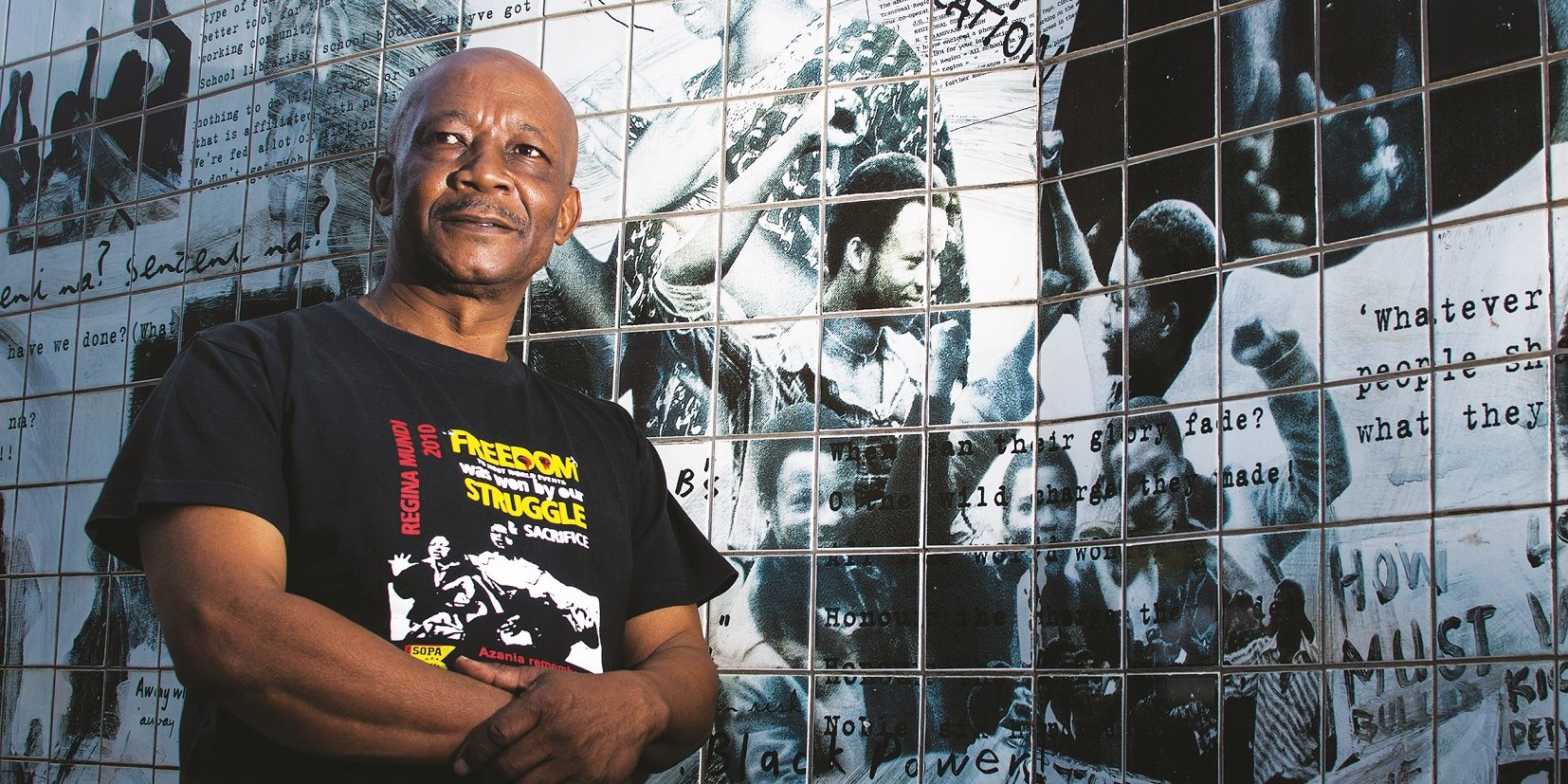
A few days later, we met again for a shoot where a statue of his friend Mashinini was erected not far from the Morris Isaacson school. He didn’t come to Soweto often but when he saw the statue, he paused, staring at it. He finally turned and we continued walking to a wall where he showed me a collage of his two friends and himself.

The story wouldn’t be complete without speaking to the ‘girl’ in the iconic photograph of Pieterson taken by Sam Nzima. Antoinette Pieterson, the older sister, who is 58 today.

READ MORE: A Soweto Boy In An Afrikaner Haven

“I saw Mbuyisa [Makhubu, the boy carrying Pieterson in the famous photograph] coming from nowhere; I didn’t know him at the time. He was running towards me, he passed me. I saw he was carrying a person and I could recognize Pieterson’s shoe, I ran with him,” she recounted.

Today, as I walk the streets of Orlando, I think of the privilege I enjoyed of choosing between either isiZulu or Afrikaans as a second language in school.

Thanks to the class of 1976, we had the freedom.

SOURCE: FORBES AFRICA

LINK:  https://www.forbesafrica.com/sometime-in-africa/2018/06/25/the-class-of-1976-soweto-uprising

“Education is one thing no one can take away from you.” —Elin Nordegren

 Mastercard Foundation Scholars Program

Mastercard Foundation


Call for Applications: Mastercard Foundation Scholars Program
at the University of the Western Cape - Academic Year 2026

The University of the Western Cape (UWC) is an implementing partner of the Mastercard Foundation Scholars Program. Initiated in 2012, the Mastercard Foundation Scholars Program is a global initiative designed to develop the next generation of transformative leaders by enabling highly talented, service-oriented young people, primarily young Africans, to pursue their higher education and cultivate their leadership potential.

The Mastercard Foundation Scholars Program is specifically targeted towards young people whose access to higher education is impeded by economic and social barriers. The Program places a particular emphasis on reaching young women, refugees and forcibly displaced youth, and persons with disabilities, who are encouraged to apply.

The Mastercard Foundation Scholars Program at UWC supports academically talented youth from South Africa and other parts of the African continent. The aim of the Program is to equip youth with the necessary tools and education to drive transformative change which will positively impact their communities and countries. For the 2026 academic year, the Mastercard Foundation Scholars Program at UWC will provide fully-funded opportunities for young scholars to study for i) undergraduate qualifications or ii) master’s degree qualifications.

Applications are restricted to the following disciplines/fields of study:

GENERAL CONDITIONS OF AWARD

  • In addition to providing support for tuition fees, the Mastercard Foundation Scholars Program at UWC provides a range of specialised resources to support Mastercard Foundation Scholars to facilitate their transition into dignified and fulfilling work. In particular, Mastercard Foundation Scholars will be provided with:

           o Pre-arrival support and an official on-boarding welcome programme;
           o Housing in a UWC residence on campus;
           o Personalised support throughout their studies, ensuring that every Mastercard Foundation Scholar has the best possible experience at UWC;
           o A monthly stipend and meal allowance;
           o Medical aid;
           o Laptop;
           o Study materials allowance; and
           o Holistic wrap around support programmes.

  • Mastercard Foundation Scholars are required to sign a scholarship agreement once they are accepted and enrolled onto the Mastercard Foundation Scholars Program at UWC.
  • Mastercard Foundation Scholars are expected to meet the required academic standards of the University to retain their scholarships.
  • The Mastercard Foundation Scholars Program at UWC provides support to the Mastercard Foundation Scholars for the duration of their registered qualification at the University.
  • Mastercard Foundation Scholars are expected to comply with the rules and regulations of the University of the Western Cape as stipulated in the University calendar.

Latest News & Announcements


SOURCE: UWC

LINK: https://www.uwc.ac.za/study/partnerships/mastercard-foundation-scholars-program

Tuesday, 9 December 2025

“Education is the vaccine of violence.” —Edward James Olmos


 Photo by Pan African Youth

Pan African University Call for Scholarships Applications Academic Year 2026-2027

Share:
November 15, 2025

The Pan African University (PAU) is an initiative of the Heads of State and Government of the African Union. It is a Premier continental university network whose mission is to provide quality postgraduate education geared towards the achievement of a prosperous, integrated and peaceful Africa.

From 2014 to date, PAU issued 2549 certificates. This involves 856 females and 1693 males from 50 Members States.

Young, qualified, talented, and enterprising applicants from African countries and the Diaspora are invited to apply to join master’s or PhD degree programmes at any of the following four PAU institutes listed below.

Youths with potential and motivation who desire to play transformative leadership roles as academics, professionals, industrialists, innovators, and entrepreneurs are particularly encouraged to apply.


Admission Requirements for master’s Programmes *

Candidates must meet the following requirements:

  1. Not  older than 25 years for male and 28 years for female applicants.
  2.  Holder of an Undergraduate degree from a recognised university, with at least a second-class upper division or its equivalent, in a relevant field.
  3. Certified true copies of relevant certificates, transcripts (from university and high school).
  4. Passport or National I.D. card (personal details page).
  5. Clear coloured passport size photograph (2cmx2cm).
  6. Detailed CV.
  7. Recommendation letter from ONE of his/her former University lecturers.
  8. Names of 3 Reference University lecturers (with email address and WhatsApp number) ;(Mandatory)

*Candidates may be required to undergo a written/oral examination after pre-   selection.

  • Candidates for the Master in Conference Interpreting and Translation programmes are required to have excellent knowledge of at least two of the African Union’s official languages (Arabic, English, French, Portuguese, Kiswahili and Spanish).

Academic Competence must be evidenced in academic transcripts at the bachelors' level.

Admission Requirements for the Doctoral (PhD) Programme

 Candidates must meet the following requirements:

  1. Maximum 28 years old for male and 30 years old for female applicants.
  2. A master’s degree in a relevant field from PAU or any internationally recognised university.
  3. Certified copies of relevant certificates and transcripts,
  4. Passport or National I.D. card (biometric/ personal details page).
  5. Clear coloured passport size photograph (2cmx2cm).
  6. Detailed CV.
  7. Recommendation letters from 2 Professors.
  8. A 3 to 4-page Research Concept Note (tentative title, research questions, objectives, significance of the research, etc.).
  9. Names of 3 Reference University lecturers (with email address and WhatsApp number); (Mandatory.)

The African Union Commission will offer full scholarships to successful candidates.


Application Procedure

Applications should be completed online at https://www.au-pau.org/submission/    

The Call will be launched on 15 November and will close on 15 December 2025.

Applications received after this deadline will NOT be considered.

Further enquiries can be made through:

pau.scholarships@africa-union.org /student.panafrican@gmail.com

SOURCE: AFRICAN UNION

LINK:  https://au.int/en/announcements/20251115/pan-african-university-call-scholarships-applications-academic-year-2026-2027